
New patios and extensions
Concrete Patios in Grand Junction, CO
A backyard floor sized to how you live outside, pitched away from the house and finished to handle strong sun.
- Free on-site estimates with a soil, drainage and irrigation check
- Itemized written quote listing thickness, base, reinforcement and finish
- We tell you up front when City of Grand Junction right-of-way rules apply
A Patio Made for Grand Valley Evenings
Concrete patios in Grand Junction get used most of the year. With more than 3,200 hours of sunshine and only about nine inches of rain a year, the backyard is where a lot of living happens, from spring evenings to warm October afternoons. A patio here also has to deal with things you might not expect in a desert: lawns and flower beds that get watered right up to its edge, and winter nights that freeze any water left on the surface. A good patio is a flat, comfortable outdoor floor that drains, does not crack across the middle, and does not get too hot or slick to use.
Signs you need a new patio, or a bigger one
- The old patio has sunk toward the house, so rain and sprinkler water run against the foundation.
- A crack runs across the slab and one side has dropped.
- The surface is flaking, pitted or worn rough.
- A small 1970s or 1980s patio no longer fits a table, a grill and a few chairs.
- You are adding a hot tub, outdoor kitchen or pergola that needs a thicker pad.
Finishes that work in the sun
A plain broom finish is the simplest and most affordable, and it gives good grip. Colored concrete (integral color mixed in at the plant) softens the glare of bright gray concrete in full sun, and lighter tones stay cooler underfoot than dark ones. Exposed aggregate shows the stones in the mix and gives a textured, grippy surface that hides dust well. Stamped concrete, covered on its own page, adds the look of stone or slate. HomeGuide prices these finishes from $4 to $12 per square foot plain up to $9 to $30 for stamped.
How we build it
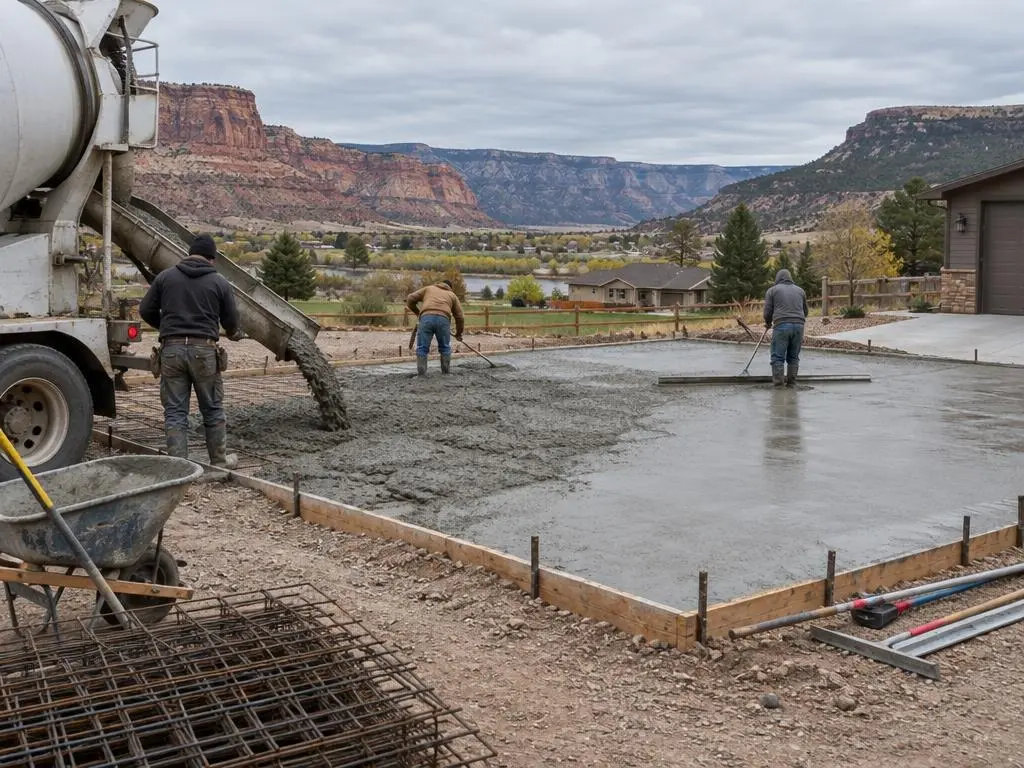
Layout comes first, marked on the ground with you. Then we dig to depth, strip the sod and organic soil, and compact a gravel base. Forms get a slight fall away from the house so water never sits against the foundation. Before pouring, we deal with nearby spray heads and drip lines, moving or re-aiming them so they stop soaking the dirt at the patio's edge; uneven wetting is one of the biggest reasons slabs shift in this valley.
A standard patio is 4 inches thick. HomeGuide's patio guide calls for 6 inches plus extra reinforcement under hot tubs and outdoor kitchens, and those areas get thickened accordingly. The mix is air-entrained, the finish is whatever you chose, and joints are tooled or sawn in a pattern that fits the shape. A sealer, penetrating or film-forming, then helps the surface resist stains and frost damage.
The first weeks
Foot traffic is fine after a day or two. Wait a few more days before setting heavy furniture or a grill on it, and let the slab reach full cure, around a month, before a hot tub is set on a new pad and filled. Wipe up grease and ash early, keep sprinkler spray off the edges, and reseal every few years so the color stays rich.
Patio Options We Build
Every patio starts with a base and slope that keep water away from the house. Then you choose the size, shape and finish.
Broom-finish patios
The simplest and most affordable patio, with a textured surface that stays grippy when wet.
Colored concrete
Integral color mixed through the concrete to cut glare and blend with stucco, stone or landscaping.
Exposed aggregate
The top layer washed back to show the stone, for texture and grip.
Patio extensions
New concrete doweled to an existing patio to add room for a table or grill area.
Hot tub and outdoor kitchen pads
Thicker, reinforced sections sized for the weight of a tub, grill island or fire feature.
Steps and landings
Concrete steps and landings from the back door down to the patio level.
Typical Concrete Patio Costs
| Patio | Published range |
|---|---|
| Plain, per sq ft | $4 to $12 |
| Broom finish, per sq ft | $6 to $13 |
| Exposed aggregate, per sq ft | $7 to $18 |
| Stained, per sq ft | $8 to $25 |
| Stamped, per sq ft | $9 to $30 |
| 12 x 12 ft plain (144 sq ft) | $600 to $1,700 |
| 16 x 16 ft plain (256 sq ft) | $1,000 to $3,100 |
| 20 x 20 ft plain (400 sq ft) | $1,600 to $4,800 |
| Rebar or wire mesh, per sq ft | $1 to $3 |
National ranges from HomeGuide's concrete patio cost guide. Your Grand Junction price depends on size, access to the backyard, removal of an old patio, thickness and finish. Your written estimate is the price.
How It Works
1. Plan the layout
We mark out size and shape with you and note doors, steps, sprinklers and drainage.
2. Excavate and base
Sod and loose dirt are dug out, gravel is compacted, and forms are pitched away from the house.
3. Pour and finish
Air-entrained concrete is placed, finished to your choice, and jointed in a clean pattern.
4. Cure and seal
We let the concrete cure and give you dates for furniture, the grill and the first coat of sealer.
Concrete Patios Questions
How much does a concrete patio cost?
HomeGuide's national ranges run $4 to $12 per square foot for a plain patio and $9 to $30 for stamped. A 16 by 16 foot plain patio comes to about $1,000 to $3,100. Backyard access, tear-out and the finish you choose make the biggest difference.
Does concrete get too hot in the sun?
Concrete stays cooler than most dark pavers or asphalt, and lighter integral colors stay cooler than dark ones. A broom or exposed aggregate finish also helps bare feet. Shade from a pergola or sail does the most.
Can I put a hot tub on a concrete patio?
Yes, if the pad is built for it. HomeGuide notes hot tubs call for 6 inches of concrete with added reinforcement, rather than a standard 4-inch patio. We build that section thicker and wait for full cure before the tub is filled.
How do I keep my patio from cracking?
A compacted base, slope away from the house, control joints at the right spacing, proper curing, and keeping sprinkler water off the edges. No slab is crack-free, but joints make cracks form in straight, planned lines.
Can you add on to my existing patio?
Most of the time. Dowels drilled into the old slab tie the new section to it so they move together. Plan on the new concrete looking a shade lighter than the old for a while.
Concrete Patios Service Areas
- Concrete Contractors in Grand Junction, CO
- Concrete Contractors in Clifton, CO
- Concrete Contractors in Fruitvale, CO
- Concrete Contractors in Orchard Mesa, CO
- Concrete Contractors in Redlands, CO
- Concrete Contractors in Fruita, CO
- Concrete Contractors in Palisade, CO
- Concrete Contractors in Loma, CO
- Concrete Contractors in Mack, CO
- Concrete Contractors in Whitewater, CO
- Concrete Contractors in Glade Park, CO
- Concrete Contractors in Collbran, CO
- Concrete Contractors in De Beque, CO
- Concrete Contractors in Mesa, CO
- Concrete Contractors in Delta, CO
- Concrete Contractors in Cedaredge, CO
- Concrete Contractors in Orchard City, CO
- Concrete Contractors in Hotchkiss, CO
- Concrete Contractors in Paonia, CO
- Concrete Contractors in Olathe, CO
Get a Concrete Patios Estimate
Describe the size and how you plan to use the patio, and we will send a written quote.