
Irrigated farm country since the Kiefer Extension in 1899
Concrete Contractors in Loma, CO
Shop floors, long drives, ag pads and patios for acreage on the west end of the valley.
- Free on-site estimates with a soil, drainage and irrigation check
- Itemized written quote listing thickness, base, reinforcement and finish
- We tell you up front when City of Grand Junction right-of-way rules apply
Rural Concrete on the West End
Loma is farm and acreage country, and most calls to concrete contractors from Loma are about working concrete: shop floors, long driveways, equipment pads and barn aisles, along with the patio by the back door. The census-designated place sits 18.5 miles northwest of Grand Junction and 5 miles past Fruita on U.S. Route 6. It covers almost 11 square miles but had only 1,314 residents and 509 housing units in 2020. That is roughly 120 people per square mile, so properties are spread out and projects tend to be bigger in footprint.
Ground that was built for irrigation
Loma's history is a history of water. The Kiefer Extension canal was completed in 1899, the Colorado Sugar Company opened 1,000 acres near Loma to settlers in 1901, and the Highline Canal was built through the area in 1917. Farm ground that has been irrigated for more than a century behaves differently from untouched desert. The Colorado Geological Survey describes how some western Colorado soils sank when first irrigated, and notes that ongoing field and landscape watering keeps adding moisture to the subsoil. Around ditches, fields and gardens, soil moisture under a slab can vary a lot from one end to the other.
Our approach for rural pours:
- Strip topsoil and organic material completely before placing base
- Build up and compact gravel base in lifts, not one thick dump
- Keep the slab above surrounding grade so water runs away from it
- Keep irrigation and ditch seepage away from slab edges where possible
Shop and barn slabs
A shop slab is often the biggest single pour on a rural property. Getting it right matters for decades. Our checklist:
Thickness. At least 4 inches for light use. More where a tractor, loaded trailer or vehicle lift will sit.
Reinforcement. Rebar on chairs so it stays in the middle of the slab during the pour.
Thickened edges and footings at walls and door openings, sized to the building.
Vapor barrier under enclosed floors to keep ground moisture out.
Floor drains or a slope to the door, decided before the pour, not after.
Control joints cut within a day so shrinkage cracks follow the lines.
Long driveways and road access
On acreage, the driveway can be the longest piece of concrete on the property. Some owners pour only the first stretch from the road to keep gravel and mud off the pavement, then switch to gravel. Others pour the full run to the house and shop. Either works. If a new driveway meets a county road, Mesa County's Development Engineering page says a driveway permit is required, and it asks applicants to flag the proposed location and allow 10 to 15 working days for processing. We plan around that review.
Patios and walks for the house
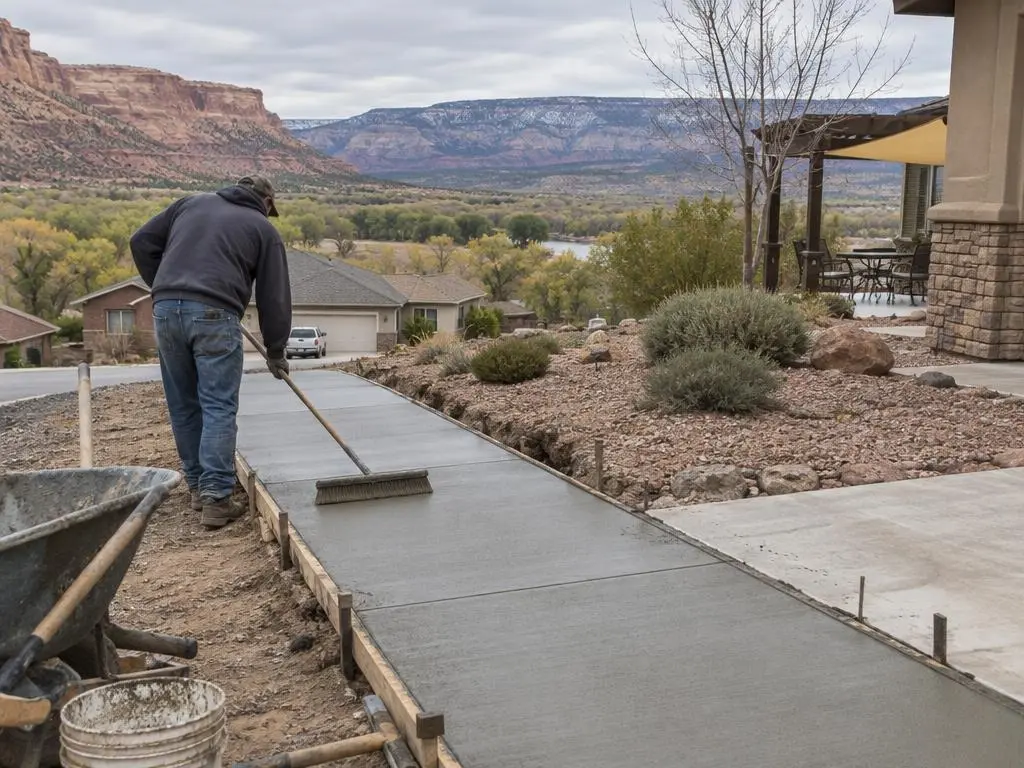
Not every Loma project is about equipment. A shaded patio facing the fields, a walk from the shop to the house, or a stamped entry are common requests on rural lots too. We can pour these on the same trip as a bigger slab to save mobilization time.
Out on Highway 139
Interstate 70 forms the southern edge of Loma, with access at Exit 15 by way of Colorado State Highway 139, which runs north 71 miles over Douglas Pass to Rangely. That route matters for scheduling ready-mix trucks: we plan delivery windows so the truck arrives with workable concrete and the crew is set up before it pulls in.
A community hall worth noticing
The Loma Community Hall, built in 1938, was added to the National Register of Historic Places in 1995. It is a good reminder that buildings here last a long time when they are cared for. The same goes for concrete. Sealing exterior slabs every few years, fixing drainage, and repairing a single panel before damage spreads can keep a rural driveway or pad working for decades.
Mixing farm work and house work
Many Loma properties are a house, a shop and some pasture or row crops on the same parcel, so one estimate visit often covers several jobs. We price each part separately, a shop slab, a driveway apron and a patio for example, so you can do them together or spread them out. Pouring them on the same day saves a second truck trip from the valley, but each slab still gets its own base, thickness and joint plan.
Loma Facts for Rural Projects
- Spread out. Loma had 1,314 residents on 10.9 square miles in 2020, about 120 people per square mile.
- Irrigation history. The Kiefer Extension canal was finished in 1899, and the Highline Canal was built through Loma in 1917.
- Location. Loma is 18.5 miles northwest of Grand Junction and 5 miles northwest of Fruita on U.S. Route 6.
- Farming today. Agriculture now centers on small cattle operations, row crops and lifestyle agriculture after sugar beets faded in the 1970s.
Loma Questions
Do I need a permit for a new driveway onto a county road near Loma?
Mesa County says a driveway permit is required for any new driveway that meets a county right-of-way. The county asks you to flag the location and allow 10 to 15 working days. We plan our schedule around that.
How thick should a shop floor be?
Four inches works for light use. For tractors, loaded trailers or a vehicle lift, we pour thicker with rebar, and the lift area may need its own thickened section per the lift maker's specs.
Can you pour on old farm ground?
Yes, with care. We strip organic topsoil fully, compact a gravel base in layers, and keep the slab above grade so irrigation water drains away from it.
Free Estimates in Loma, CO
Free estimates for Loma shop slabs, driveways, pads and patios.
Concrete Contractors Near Loma
- Concrete Contractors in Grand Junction, CO
- Concrete Contractors in Clifton, CO
- Concrete Contractors in Fruitvale, CO
- Concrete Contractors in Orchard Mesa, CO
- Concrete Contractors in Redlands, CO
- Concrete Contractors in Fruita, CO
- Concrete Contractors in Palisade, CO
- Concrete Contractors in Mack, CO
- Concrete Contractors in Whitewater, CO
- Concrete Contractors in Glade Park, CO
- Concrete Contractors in Collbran, CO
- Concrete Contractors in De Beque, CO
- Concrete Contractors in Mesa, CO
- Concrete Contractors in Delta, CO
- Concrete Contractors in Cedaredge, CO
- Concrete Contractors in Orchard City, CO
- Concrete Contractors in Hotchkiss, CO
- Concrete Contractors in Paonia, CO
- Concrete Contractors in Olathe, CO