
Nearly 7,000 feet up, above the monument
Concrete Contractors in Glade Park, CO
Slabs, pads and patios for 35-acre parcels and self-reliant homes on the plateau.
- Free on-site estimates with a soil, drainage and irrigation check
- Itemized written quote listing thickness, base, reinforcement and finish
- We tell you up front when City of Grand Junction right-of-way rules apply
High-Elevation Concrete on the Plateau
Glade Park is a different world from the valley floor, and concrete contractors working in Glade Park have to plan for altitude, distance and self-reliant homes. The unincorporated community sits at about 7,000 feet, roughly 16 miles west of downtown Grand Junction. It is reached by Little Park Road or by Rim Rock Drive through Colorado National Monument, which climbs about 2,500 feet over 4 miles of hairpin curves. Former ranch land here was split into 35 to 40 acre parcels, and zoning allows one house per 35-acre parcel.
Cooler, and sometimes warmer
Wikipedia notes that Glade Park typically runs about 10 degrees cooler than Grand Junction, though winter inversions in the valley can sometimes leave the plateau warmer. For concrete, cooler means a shorter season for easy pours and more freeze-thaw cycles. We plan accordingly:
- Air-entrained mixes on every outside pour
- Accelerating admixtures or heated water in the cool months
- Insulated blankets on fresh slabs when nights drop below freezing
- Steeper drainage on exposed pads so snowmelt runs off quickly
Getting the truck up the hill
A loaded concrete truck is heavy and slow on steep, winding roads. We pick the route ahead of time, confirm weight and length limits, and allow extra haul time in the schedule. On long hauls, retarding admixtures keep the concrete workable until it reaches the forms. For remote sites, we sometimes recommend fewer, larger pours rather than many small ones to make the trip worthwhile.
Built for off-grid living
Glade Park has no municipal water system. Wikipedia reports most homes use wells, with the water table around 500 feet down, and some collect roof water. Many lots are far from power lines, and the area has a high share of alternative homes: earthships, rammed earth, straw bale, domes, berm and log construction. Concrete supports a lot of that:
Cistern and tank pads, level and strong enough for thousands of gallons of water.
Solar equipment and battery pads, raised above grade and sloped to shed water.
Generator pads with anchor points.
Slab floors for small cabins and outbuildings, often with a vapor barrier and insulation beneath.
Thermal mass floors for passive solar homes, which we pour and finish to a smooth, sealable surface.
Driveways on big parcels
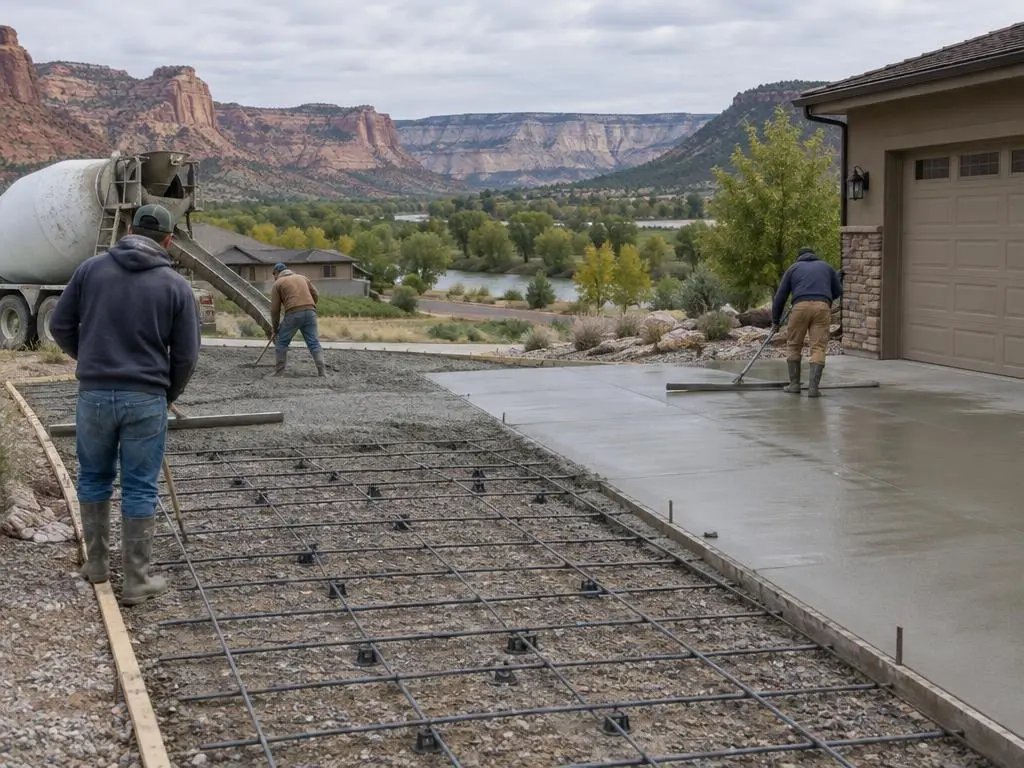
On a 35-acre parcel, the driveway can be long. Most owners pave only the most important parts: the apron where it meets the road, a turnaround by the house, and the area in front of the garage. That gives you a clean, mud-free work zone without paving the whole run.
Patios with the view
At this height, the patio is often the reason people live here. A broom-finished or stamped patio facing the canyon country makes a strong outdoor room. Because of stronger sun and colder nights, we seal decorative concrete and recommend sand instead of salt in winter.
Thermal mass floors, done right
For passive solar homes, a slab floor stores the day's sun and releases it at night. To work well, the slab needs good contact with the sun through south-facing glass, insulation under and around it so heat is not lost to the ground, and a dark or stained finish to absorb light. We pour these floors flat and dense, cure them slowly to limit cracking, and can leave the surface ready for a stain or a polished finish.
Water for the pour
With no municipal water and wells reaching a water table around 500 feet down, water on site is not something to take for granted in Glade Park. Concrete arrives already mixed, but curing still calls for water to keep the slab damp, and cleanup needs some too. On these jobs we use curing compound or curing blankets instead of a running hose where we can, and we ask about your tank or well capacity before pour day.
Glade Park Conditions
- Elevation. Glade Park sits at about 7,000 feet and typically runs about 10 degrees cooler than Grand Junction.
- Steep access. Rim Rock Drive through Colorado National Monument climbs about 2,500 feet over 4 miles of hairpin curves; Little Park Road is the other route.
- Large parcels. Ranch land was divided into 35 to 40 acre parcels, and zoning allows one house per 35-acre parcel.
- Wells and roof water. There is no municipal water system; most homes use wells with the water table about 500 feet down, and some collect roof water.
Our Services in Glade Park, CO
Glade Park Questions
Can a concrete truck make it up to Glade Park?
Yes, with planning. We choose the route ahead of time, check road limits, allow more haul time, and use retarding admixtures so the concrete stays workable on arrival.
Can you pour a pad for a water cistern or solar batteries?
Yes. We pour level, reinforced pads sized to the full weight of the tank or equipment, slightly above grade and sloped to shed water.
Is the pour season shorter in Glade Park?
It is, since it runs about 10 degrees cooler than the valley. We pour in warmer months when we can and use heated water, accelerators and blankets when the weather is cooler.
Free Estimates in Glade Park, CO
Free estimates for Glade Park slabs, pads, driveways and patios.
Concrete Contractors Near Glade Park
- Concrete Contractors in Grand Junction, CO
- Concrete Contractors in Clifton, CO
- Concrete Contractors in Fruitvale, CO
- Concrete Contractors in Orchard Mesa, CO
- Concrete Contractors in Redlands, CO
- Concrete Contractors in Fruita, CO
- Concrete Contractors in Palisade, CO
- Concrete Contractors in Loma, CO
- Concrete Contractors in Mack, CO
- Concrete Contractors in Whitewater, CO
- Concrete Contractors in Collbran, CO
- Concrete Contractors in De Beque, CO
- Concrete Contractors in Mesa, CO
- Concrete Contractors in Delta, CO
- Concrete Contractors in Cedaredge, CO
- Concrete Contractors in Orchard City, CO
- Concrete Contractors in Hotchkiss, CO
- Concrete Contractors in Paonia, CO
- Concrete Contractors in Olathe, CO