
Plateau Creek ranch country at almost 6,000 feet
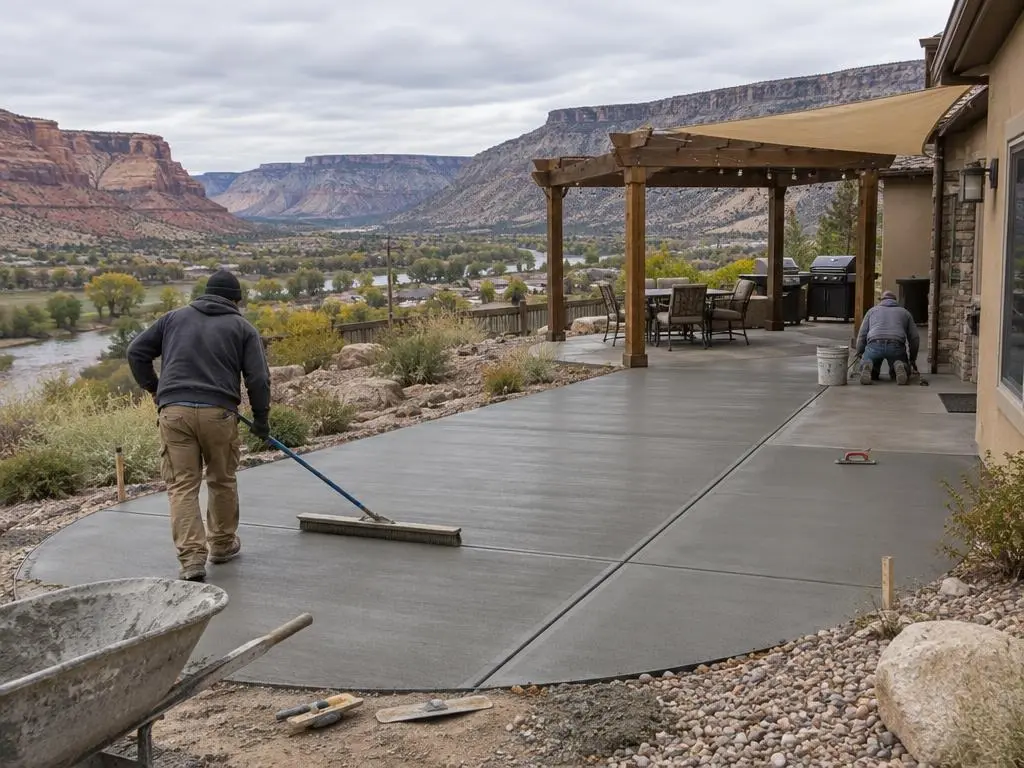
Concrete Contractors in Collbran, CO
Ranch slabs, driveways and patios for a small mountain town on the way to Grand Mesa.
- Free on-site estimates with a soil, drainage and irrigation check
- Itemized written quote listing thickness, base, reinforcement and finish
- We tell you up front when City of Grand Junction right-of-way rules apply
Concrete for the Plateau Valley
Collbran sits higher and colder than the Grand Valley, and concrete contractors working for Collbran homeowners and ranchers plan for that from the first visit. The statutory town lies at 5,988 feet along Plateau Creek, at the eastern end of the Plateau Valley, a small cattle-ranching valley east of Grand Junction. It is a gateway to Vega State Park and the northeast side of Grand Mesa by way of the Grand Mesa Scenic and Historic Byway. The town itself is small, covering about 357 acres, with 369 residents counted in 2020.
A continental climate, not a desert one
Wikipedia classifies Collbran as warm-summer continental, not semi-arid like the valley floor. January averages a high of 35 and a low of 10 degrees. July runs from about 50 at night to 86 in the afternoon. Annual precipitation is about 15 inches, well above Grand Junction. For concrete that means:
- More freeze-thaw cycles and more moisture to freeze in the surface
- A narrower window for comfortable pours
- More need for drainage away from slabs
We use air-entrained concrete on every exterior job, pay close attention to slope, and recommend a penetrating sealer to slow water from getting into the surface.
Ranch slabs
Cattle country needs working concrete:
Feed bunk aprons that stay firm where animals stand and tractors turn.
Barn alleys and tack room floors, broom-finished for grip and sloped to drain.
Waterer pads around tanks, where constant moisture and hoof traffic break down dirt fast.
Equipment and hay slabs that keep machinery and bales off wet ground.
These slabs see more abuse than a house driveway. We thicken them, reinforce them with rebar, and roughen the finish where animals walk.
In town: drives, walks and steps
Inside Collbran, most work is about the house: replacing an old driveway, adding a walk from the street, or rebuilding front steps that have heaved. Older town homes often have thin, unreinforced flatwork that has broken up after years of hard winters. Replacing it with air-entrained concrete on a compacted base, with joints at proper spacing, gives you a slab built for this climate.
Hauling concrete up the valley
Collbran is a long haul from the valley's ready-mix plants, and the road climbs. We schedule deliveries with that time in mind, use set-retarding admixture in warm weather so the load stays workable, and have forms and reinforcement checked and ready before the truck rolls. On cool days, we may ask for heated water or an accelerator instead.
Snow and freeze on new concrete
Fresh concrete must not freeze before it gains strength. In Collbran's shoulder seasons, we check the overnight forecast before every pour, keep blankets on site, and leave forms in place a little longer. We also tell homeowners to skip de-icing salt the first winter and use sand for traction.
Seal and maintain
In a colder, wetter climate, maintenance makes a bigger difference. We suggest a penetrating silane or siloxane sealer on drives and walks about every two to three years. Keep joints filled with a flexible sealant so water cannot run under the slab and freeze there. Clear snow promptly instead of letting it pack down and refreeze, and use sand for grip instead of salt.
Driveway permits
If your project creates a new driveway onto a county road outside town, Mesa County says a driveway permit is required, and processing takes 10 to 15 working days. Inside town limits, we check with the Town of Collbran on what applies. Call (970) 367-1391 to set up a visit.
Collbran Conditions
- Elevation. Collbran sits at 5,988 feet along Plateau Creek, at the eastern end of the Plateau Valley.
- Colder climate. The town has a warm-summer continental climate, with January averaging a high of 35 and a low of 10 degrees.
- More precipitation. Annual precipitation averages about 15 inches, more than the Grand Valley floor.
- Gateway town. Collbran is a gateway to Vega State Park and the northeast side of Grand Mesa via the scenic byway.
Our Services in Collbran, CO
Collbran Questions
Is it harder to pour concrete in Collbran than in Grand Junction?
It takes more planning. The town is higher, colder and wetter, and the haul is longer. We use air entrainment, time deliveries carefully and protect fresh slabs from frost.
Can you pour a waterer pad for livestock?
Yes. We pour a thick, reinforced pad with a rough broom finish around the tank, sloped so overflow drains away from the waterer.
Why do driveways in Collbran crack so badly?
Many older slabs were thin, unreinforced and not air-entrained. With 15 inches of precipitation and cold winters, water gets in and freezes. A new slab built for the climate holds up much better.
Free Estimates in Collbran, CO
Free estimates for Collbran ranch slabs, driveways and walks.
Concrete Contractors Near Collbran
- Concrete Contractors in Grand Junction, CO
- Concrete Contractors in Clifton, CO
- Concrete Contractors in Fruitvale, CO
- Concrete Contractors in Orchard Mesa, CO
- Concrete Contractors in Redlands, CO
- Concrete Contractors in Fruita, CO
- Concrete Contractors in Palisade, CO
- Concrete Contractors in Loma, CO
- Concrete Contractors in Mack, CO
- Concrete Contractors in Whitewater, CO
- Concrete Contractors in Glade Park, CO
- Concrete Contractors in De Beque, CO
- Concrete Contractors in Mesa, CO
- Concrete Contractors in Delta, CO
- Concrete Contractors in Cedaredge, CO
- Concrete Contractors in Orchard City, CO
- Concrete Contractors in Hotchkiss, CO
- Concrete Contractors in Paonia, CO
- Concrete Contractors in Olathe, CO