
Where the Colorado and Gunnison rivers meet
Concrete Contractors in Grand Junction, CO
Driveways, patios, walkways and slabs poured for a dry valley at 4,646 feet with real winters.
- Free on-site estimates with a soil, drainage and irrigation check
- Itemized written quote listing thickness, base, reinforcement and finish
- We tell you up front when City of Grand Junction right-of-way rules apply
Concrete Built for the Grand Valley
As concrete contractors in Grand Junction, we work across every part of the city, from the older blocks near downtown to newer subdivisions on the north side. The city sits at 4,646 feet where the Gunnison River joins the Colorado, inside a valley roughly 30 miles long and 5 miles wide. That setting brings dry air, strong sun and cold nights. Each of those affects how concrete should be mixed, placed and cured, and each one shows up later as cracks, scaling or settling when it is ignored.
A desert climate that still freezes
Wikipedia's climate summary lists Grand Junction as cold semi-arid, with about 9 inches of precipitation a year and roughly 17.6 inches of seasonal snow. That sounds mild, but the same data shows a record low of 23 below zero and an average first freeze on October 11. Nights below freezing come every winter, and a light snow that melts by noon and refreezes after dark is exactly what wears down a driveway surface.
Our answer is simple and standard for this climate:
- Air-entrained mixes for all outdoor flatwork, so tiny air pockets give freezing water room to expand
- A broom finish or textured surface on drives and walks for grip on icy mornings
- No de-icing salt the first winter, and sand or plain traction grit after that when you can
- A breathable sealer on exposed slabs to slow water from soaking in
Summer pours need a plan
The same records show about 68 days a year at 90 degrees or hotter and a record high of 107. Hot, dry air pulls water out of fresh concrete fast. If the top dries before the slab below it, you get plastic shrinkage cracks and a weak, dusty surface. On summer jobs we schedule pours for early morning, dampen the base before placing, and keep the slab moist or covered with a curing compound for the first days. We would rather move a pour a day than place a patio in afternoon heat and wind.
Permits for work near the street
The City of Grand Junction's permits page says a right-of-way permit is required for any work within the public right-of-way, and it lists driveway changes, curb and gutter, and sidewalk work among the examples. The Engineering Division handles those questions. So if you want a wider driveway apron, a new curb cut or a replaced section of public sidewalk, we plan for that permit before we set a date. Work that stays entirely on your lot, like a backyard patio, usually falls outside the right-of-way rules, but we check your situation before we start.
Six services, one valley
Concrete driveways. A standard residential drive is 4 inches thick on a compacted gravel base. We go thicker where trucks, trailers or an RV will park, and we cut control joints deep enough to steer cracks into straight lines.
Concrete patios. A backyard slab gets full sun most of the year. We slope it away from the house so summer storms and sprinkler water drain off instead of pooling at the foundation.
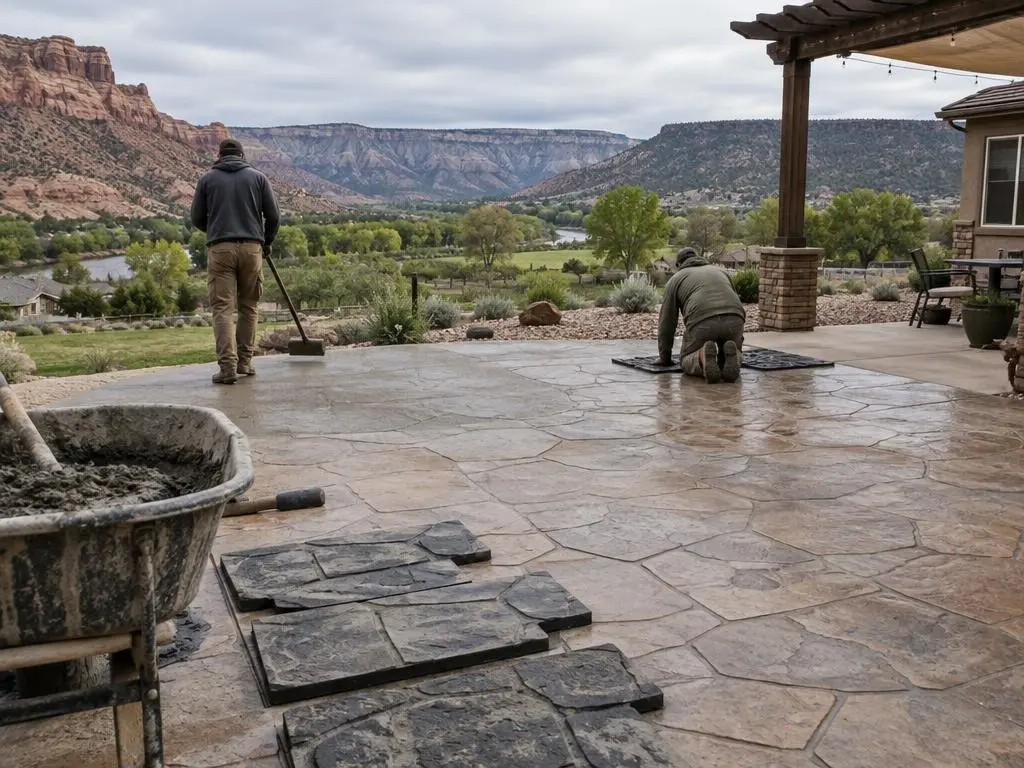
Stamped concrete. Stone and slate patterns are popular for patios and front walks. We use release agents and color hardeners suited to strong UV, then seal the surface so the color holds.
Sidewalks and walkways. Front walks, side-yard paths and steps get a textured finish and joints at close, even spacing.
Concrete slabs. Shed pads, hot tub bases, RV pads and garage slabs each get a base and thickness matched to their load.
Concrete repair. Cracked or sunken sections are often a base or drainage problem. We look for the cause first, then repair or replace only what needs it.
Growth means a mix of old and new concrete
Grand Junction grew from 41,986 people in 2000 to 65,560 in 2020, and the city had 29,431 housing units at the 2020 census. That growth left a wide spread of ages in residential concrete. Older parts of town have driveways and walks that have been through decades of freeze-thaw. Newer neighborhoods have flatwork that can show early cracking if the base was rushed during a building boom. We price both kinds of work the same way: by measuring, checking the base and drainage, and writing down exactly what we plan to remove and pour.
Water and the soil under your slab
The Colorado Geological Survey describes collapsible soils in western Colorado's semi-arid river valleys: dry, loose, silty ground that can settle when it gets wet. Irrigation and lawn watering are among the sources of that water. We cannot tell what is under your yard from the street, but we can see the signs, like a patio that dropped near a sprinkler head or a walk that sank along a downspout. When we pour new work, we compact the base in lifts, keep downspouts discharging away from slabs, and talk with you about where irrigation lines and spray heads sit near the concrete.
Where the old and new parts of town differ
Census survey figures (ACS 2019-2023) put the median Grand Junction home at about 1988, with roughly 16 percent built in the 1970s, close to 9 percent built in 1939 or earlier, and about 18.5 percent built in the 2000s. Those groups tend to call about different things. Blocks of pre-war and 1970s houses have narrow single-car driveways, steps that have pulled away from porches, and walks lifted by old street trees. Homes from the 2000s more often have a driveway that dropped where it crosses foundation backfill, or a patio edge that sank beside a lawn zone. Knowing the age of the house tells us what to look for before we arrive.
Grand Junction Facts That Affect Concrete
- Elevation and rivers. The city sits at 4,646 feet at the confluence of the Colorado and Gunnison rivers, in a valley about 30 miles long and 5 miles wide.
- Freeze season. The average first freeze comes on October 11 and the average last freeze on April 25, with a record low of 23 below zero.
- Dry, hot summers. Annual precipitation is about 9 inches, and the city averages roughly 68 days a year at or above 90 degrees.
- Right-of-way permit. The city requires a permit for any work in the public right-of-way, including driveway changes, curb and gutter, and sidewalks.
Our Services in Grand Junction, CO
Grand Junction Questions
Do I need a city permit to widen my driveway in Grand Junction?
If the work reaches the public right-of-way, such as the apron, curb cut or public sidewalk, the city's permits page says a right-of-way permit is required. Work that stays on your lot is handled differently. We confirm which applies before we schedule.
When is the right time of year to pour concrete in Grand Junction?
Late spring and early fall are easiest, after the average last freeze around April 25 and before the first one around October 11. Summer pours work fine when they start early in the morning and the slab is cured carefully. In winter we watch overnight lows and protect fresh concrete with blankets when we pour at all.
Why did my patio crack even though we hardly get rain?
Most cracks come from shrinkage, a poorly compacted base, or water from sprinklers and downspouts softening the soil under one side. Freeze-thaw also opens small cracks wider each winter. We look for the cause before we recommend repair or replacement.
Free Estimates in Grand Junction, CO
Free on-site estimates anywhere in Grand Junction, from downtown to the north side.
Concrete Contractors Near Grand Junction
- Concrete Contractors in Clifton, CO
- Concrete Contractors in Fruitvale, CO
- Concrete Contractors in Orchard Mesa, CO
- Concrete Contractors in Redlands, CO
- Concrete Contractors in Fruita, CO
- Concrete Contractors in Palisade, CO
- Concrete Contractors in Loma, CO
- Concrete Contractors in Mack, CO
- Concrete Contractors in Whitewater, CO
- Concrete Contractors in Glade Park, CO
- Concrete Contractors in Collbran, CO
- Concrete Contractors in De Beque, CO
- Concrete Contractors in Mesa, CO
- Concrete Contractors in Delta, CO
- Concrete Contractors in Cedaredge, CO
- Concrete Contractors in Orchard City, CO
- Concrete Contractors in Hotchkiss, CO
- Concrete Contractors in Paonia, CO
- Concrete Contractors in Olathe, CO